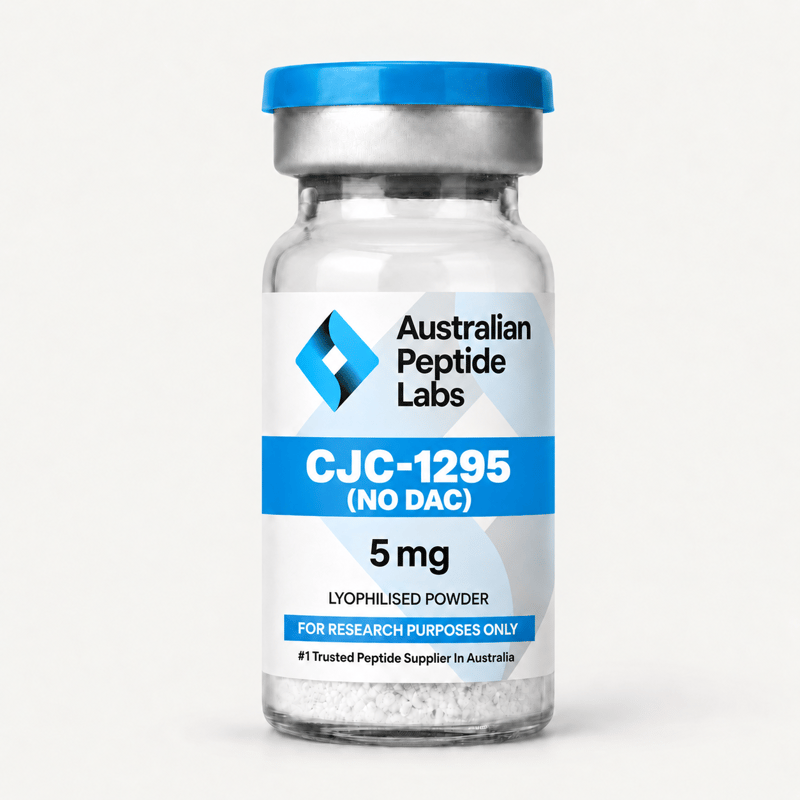
CJC-1295 (No DAC)
Research Grade
$85
$85.00
$85.00 / vial
Add this and you're $115.00 from free express shipping
Then a free bac water at $300.
Free shipping $200 bac water $300 free vial $500
Same day dispatch
Testing & Certificates
Tested twice · two labsOzcanium Analytics
Independent Australian laboratory. One report covers every vial size; each opens as issued.
Purity & identity
99.48%
28 August 2026
- Method
- UPLC-MS/MS
- Lot
- APL-CJC5-2608-01
- Net content
- 4.88 mg
- Code
- OZ-HPLCMS-TS04
Bacterial endotoxin
< 15.0EU/vial
Below the reportable limit at the dilution tested
30 August 2026
- Method
- kinetic chromogenic LAL
- Code
- OZ-ENDOTX-TAU1
Enter a code in the Ozcanium verification portal (opens in a new tab) to confirm either report against the lab's own records.
Full verification statement
CJC-1295 (No DAC) is independently verified by Ozcanium Analytics, an independent Australian laboratory, at 99.48% purity by UPLC-MS/MS, analysed 28 August 2026 on lot APL-CJC5-2608-01, net content 4.88 mg, verification code OZ-HPLCMS-TS04; bacterial endotoxin below 15.0 EU per vial by kinetic chromogenic LAL, analysed 30 August 2026, verification code OZ-ENDOTX-TAU1.
Certificates of Analysis
HPLC and mass spectrometry on every batch, published in full. Match the batch number printed on your vial.
- APL-CJC10-2610-05 on shelfTested 23 October 202699.21%
- APL-CJC10-2609-04 Tested 19 September 202699.09%
- APL-CJC10-2608-03 Tested 20 August 202698.97%
- APL-CJC10-2607-02 Tested 19 July 202698.63%
- APL-CJC10-2606-01 Tested 19 June 202698.52%
Molecular Details
Usage & Storage
Description
DPP-4-resistant 29 amino acid GHRH analogue without DAC. Short ~30 minute half-life, studied in pulsatile growth hormone release research.
- 29 amino acid GHRH analogue (Modified GRF 1-29)
- D-Ala2, Gln8, Ala15, Leu27 substitutions resist DPP-4 cleavage
- No DAC — short ~30 minute plasma half-life
- Studied in pulsatile GH-release research models
- Research Grade purity >=98%
CJC-1295 without DAC — also known as Modified GRF (1-29) or Mod GRF — is a 29 amino acid analogue of endogenous growth hormone releasing hormone (GHRH), carrying four amino acid substitutions (D-Ala2, Gln8, Ala15, Leu27) that confer resistance to dipeptidyl peptidase-4 (DPP-4) cleavage and improve plasma stability relative to native GHRH(1-29). Because it omits the Drug Affinity Complex (DAC) — the maleimidopropionyl linker that binds covalently to serum albumin in the DAC variant — it retains a short plasma half-life of roughly 30 minutes. This makes it the form studied in models of discrete, pulsatile growth hormone release rather than sustained elevation, more closely mimicking the endogenous secretory rhythm. Research has characterised its binding at the GHRH receptor on anterior pituitary somatotrophs and the resulting G-protein coupled cascade through adenylyl cyclase, cAMP and protein kinase A. It is frequently studied in combination with GHRP-class secretagogues, which act through an entirely independent receptor system. Supplied as a lyophilised white powder with a molecular weight of approximately 3367 Da and molecular formula C152H252N44O42. Supplied strictly for in-vitro laboratory research. Not for human or veterinary consumption.
Frequently Asked Questions
Is CJC-1295 (No DAC) legal to buy in Australia?
CJC-1295 (No DAC) is supplied strictly as a research chemical for in-vitro laboratory use. It is not approved for human therapeutic use in Australia and is not for human or animal consumption. Researchers are responsible for compliance with Therapeutic Goods Administration (TGA) regulations and their institution's protocols.
Is CJC-1295 (No DAC) third-party tested?
Yes. CJC-1295 (No DAC) is independently verified by Ozcanium Analytics, an independent Australian laboratory, at 99.48% purity by UPLC-MS/MS, analysed 28 August 2026 on lot APL-CJC5-2608-01, net content 4.88 mg, verification code OZ-HPLCMS-TS04; bacterial endotoxin below 15.0 EU per vial by kinetic chromogenic LAL, analysed 30 August 2026, verification code OZ-ENDOTX-TAU1. The reports are published in full on this page, and each verification code can be redeemed in the laboratory's own portal, so the document is confirmed against their records rather than ours. Every batch is also analysed in-house by HPLC and mass spectrometry and ships with a batch-specific Certificate of Analysis.
What purity is CJC-1295 (No DAC)?
CJC-1295 (No DAC) is independently verified by Ozcanium Analytics at 99.48% purity by UPLC-MS/MS, analysed 28 August 2026. We specify ≥98% purity — the High-Tier Research Grade (commercial RUO) standard — and every batch is also analysed in-house by HPLC and mass spectrometry and ships with a batch-specific Certificate of Analysis.
Does CJC-1295 (No DAC) ship with a Certificate of Analysis (COA)?
Yes — every batch ships with a batch-specific COA documenting HPLC purity and mass-spectrometry identity. 5 CJC-1295 (No DAC) batch certificates are published in full at australianpeptidelabs.com.au/certificates/cjc-1295, so the analysis can be read before ordering and the batch number printed on the vial matched against it.
Where can I buy CJC-1295 (No DAC) in Australia?
CJC-1295 (No DAC) can be ordered here from Australian Peptide Labs for in-vitro research use, dispatched same day from within Australia with a COA included.
Do you provide dosing or administration guidance for CJC-1295 (No DAC)?
No. As these compounds are supplied for laboratory research only, we do not provide dosing or administration protocols. Our research library covers reconstitution and concentration calculations for in-vitro work.