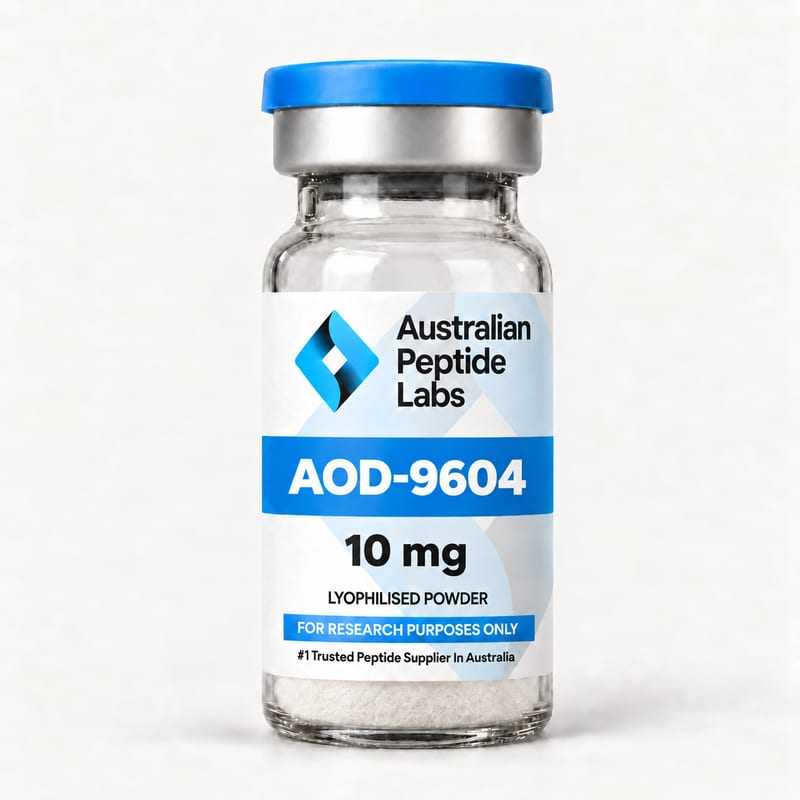
AOD-9604
Research Grade
$85
$85.00
$85.00 / vial
Add this and you're $115.00 from free express shipping
Then a free bac water at $300.
Free shipping $200 bac water $300 free vial $500
Same day dispatch
Molecular Details
Usage & Storage
Description
Modified C-terminal hGH(177-191) fragment. Studied in adipocyte lipid metabolism research models.
- Modified hGH(177-191) C-terminal fragment
- 16 amino acids with an intramolecular disulfide bridge
- Studied in adipocyte lipolysis and lipogenesis models
- Investigated in cartilage and connective tissue research
- Research Grade purity >=98%
AOD-9604 is a synthetic 16 amino acid peptide based on the C-terminal region (residues 177-191) of human growth hormone, with an added N-terminal tyrosine, identified by CAS number 221231-10-3. It contains a disulfide bridge between its two cysteine residues. Unlike full-length growth hormone, the fragment does not bind the growth hormone receptor in the same way. Research has examined its activity on lipolysis and lipogenesis in adipocyte models and on cartilage and connective tissue in preclinical studies. Supplied as a lyophilised white powder with a molecular weight of 1815.1 Da and molecular formula C78H123N23O23S2. Supplied strictly for in-vitro laboratory research. Not for human or veterinary consumption.
Research & Guides
Frequently Asked Questions
Is AOD-9604 legal to buy in Australia?
AOD-9604 is supplied strictly as a research chemical for in-vitro laboratory use. It is not approved for human therapeutic use in Australia and is not for human or animal consumption. Researchers are responsible for compliance with Therapeutic Goods Administration (TGA) regulations and their institution's protocols.
Where can I buy AOD-9604 in Australia?
AOD-9604 can be ordered here from Australian Peptide Labs for in-vitro research use, dispatched same day from within Australia.
Do you provide dosing or administration guidance for AOD-9604?
No. As these compounds are supplied for laboratory research only, we do not provide dosing or administration protocols. Our research library covers reconstitution and concentration calculations for in-vitro work.